Embedded Circularity
The Garland was never a Decoration
Do we ever throw anything away? And what if it is something made from love and days of hard work? Weaving communities, like many others across the Indian subcontinent, hold rather than hoard their deadstock and misweaves with care. Women in the household repair and rework these pieces to decorate their homes. This practice is a silent symbolism of hope and offers a model for the kind of circularity the world is now attempting to construct. Here, circularity is not a future to be engineered; it is already embedded in everyday habits and practices.
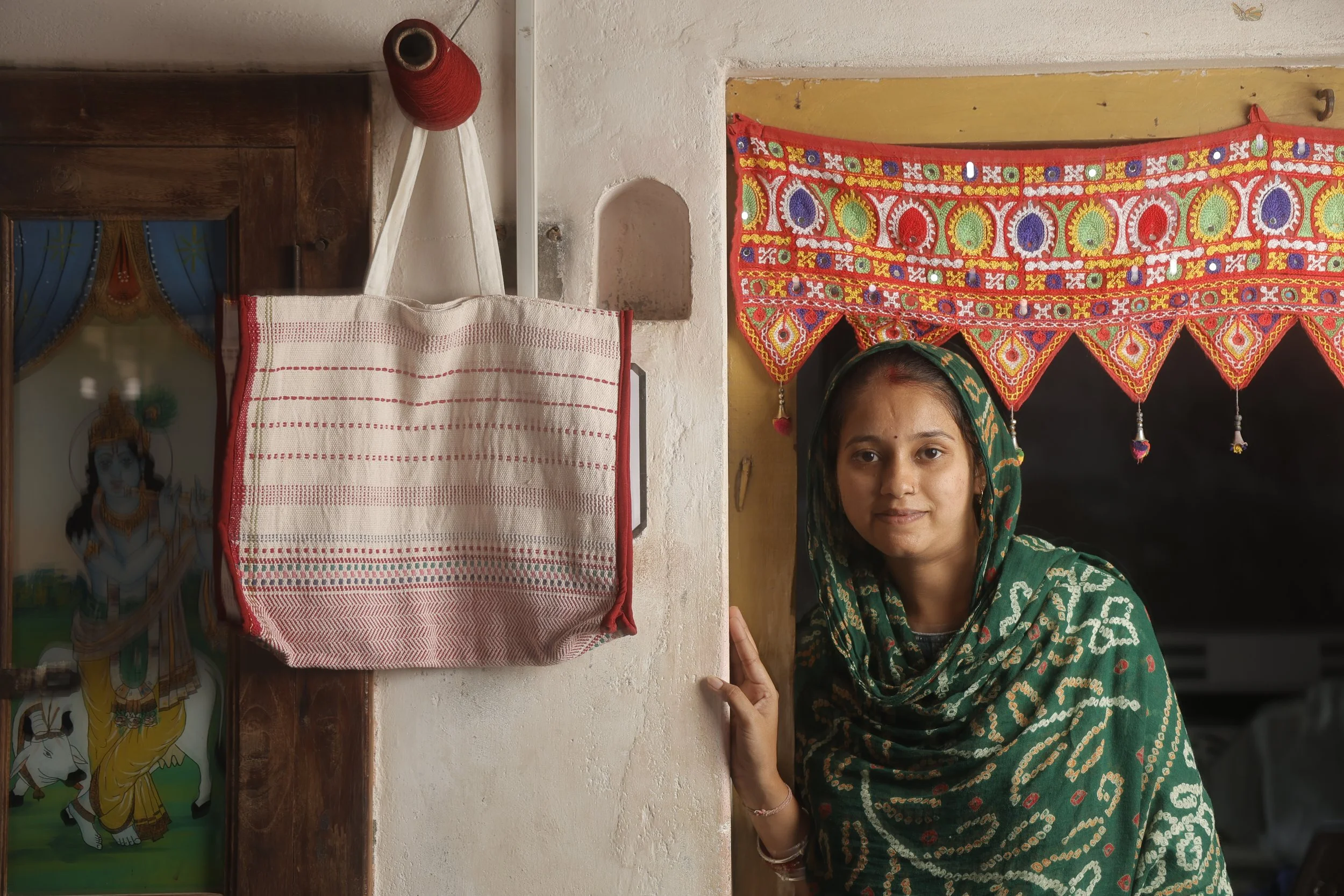
A woman at the threshold of her family’s weaving house in Bhujodi, Kutch. The tote bag beside her is woven from a length that did not meet a buyer’s specification; the embroidered toran above the door marks the most protected surface of the house.
Above the entrance to a weaver’s house in Bhujodi hangs a strip of cloth cut to the width of the doorframe, edged with small woollen pom-poms and weighted so that its points fall evenly. It is a toran: a decorative garland for the threshold, hung so everyone who enters passes beneath it. In this village, and in dozens of others like it, the toran is often made from cloth rejected by the market.
Misweaves happen because a human is behind the loom. A shawl may come off the loom with a miscounted motif. A length may be woven in a shade that differs slightly from the buyer’s reference. Two pieces of an order may fail to match across dye lots. A wholesaler may cancel an order after the yarn has already been placed on the beam. Whatever the reason, the cloth is disqualified somewhere between the loom and the shop, after which it remains in the household. What happens to it next is the aspect of the handloom industry that has been conveniently overlooked for years.
What the house already knows
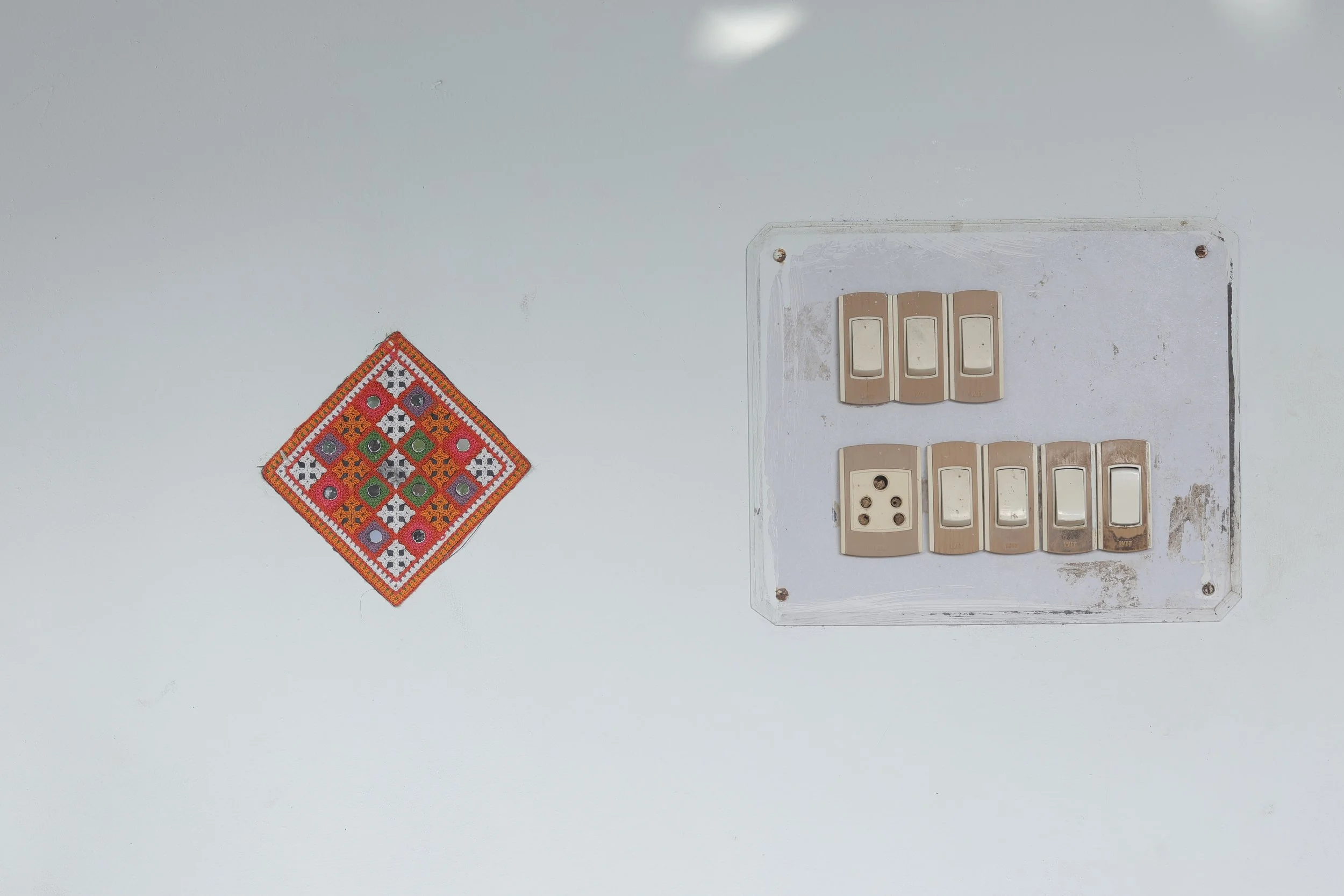
A single embroidered square, salvaged and fixed to the wall beside the switchboard.
Walk through a weaving household in Kutch, and one can read the afterlife of failed cloth from the walls. A tote bag in fine cotton, its stripes broken where the extra weft went wrong, hangs from a cone of red yarn beside the shrine. A woven pouch, softened almost colorless by use, hangs beside a long-disused kerosene lantern. A small embroidered square, with mirrors catching the afternoon sun, is fixed to the plaster next to a bank of plastic light switches, one bright diamond of surplus against eight identical rockers. From a peg near the roof beam, a fragment of striped weave turns slowly on a thread.
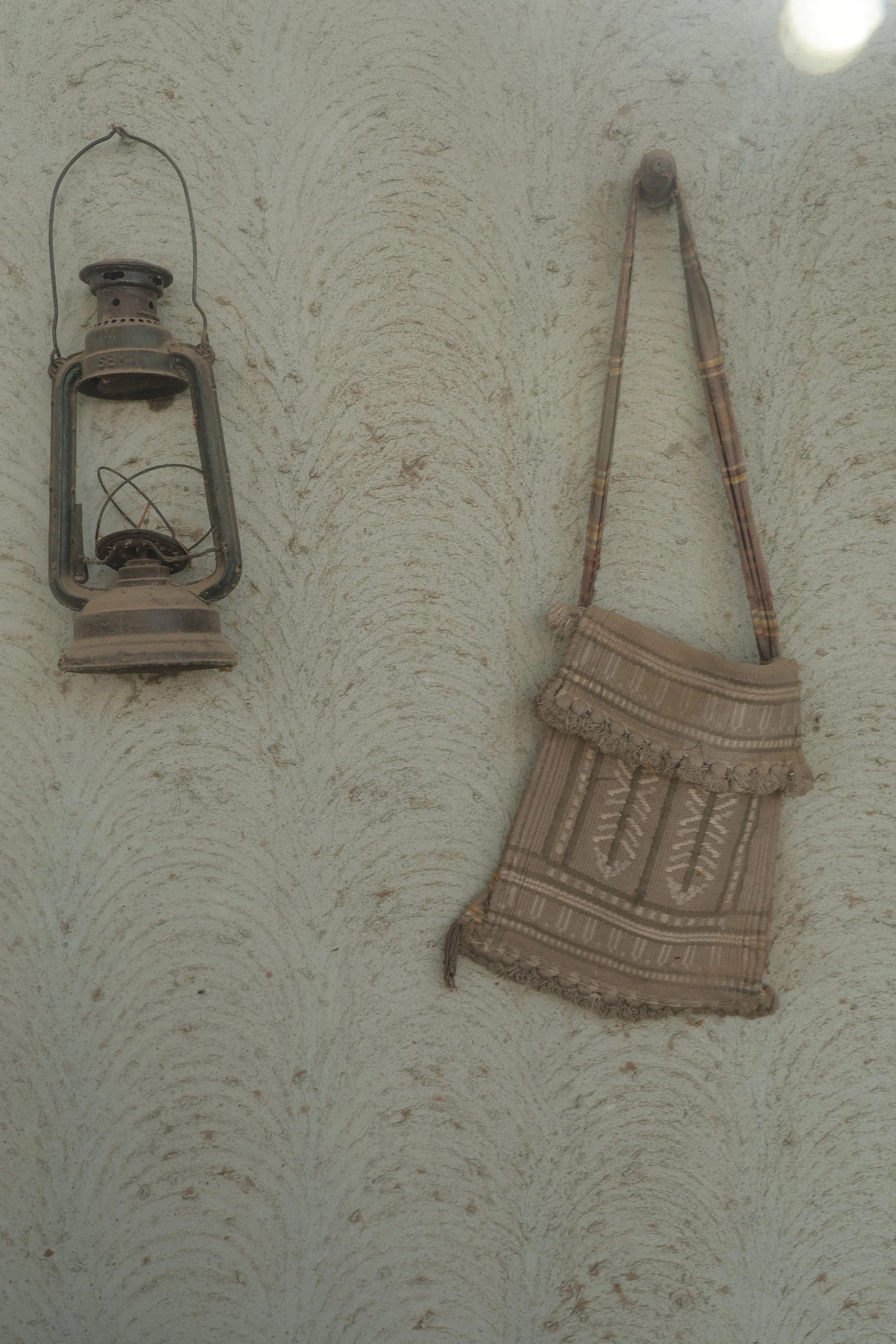
A woven shoulder bag hangs beside a disused kerosene lantern, two objects kept long past their commercial life.
None of these things had a brief. None were asked to be designed. Nobody made a mood board, and, most importantly, nobody called the outcome upcycling. The women of the household looked at the rejected piece of cloth that had lost their market value and decided where it should go within the house.
That decision is not casual. The garland goes at the threshold, welcoming guests and marking the line that the household protects, blesses, and sweeps. Something the market has refused is given a position of high ritual visibility; a commercial failure is re-qualified, in one gesture, as a household good and an auspicious object. This shift in value constitutes a form of value transformation that predates contemporary circular-economy strategy.
Women’s hands at both ends of the loom
It matters that this is women’s work. In many handloom households, the loom is predominantly a man’s station, and the loom is what official statistics tend to count. The Fourth All India Handloom Census (2019–2020) records approximately 26.7 million weavers and 8.5 million allied workers and notes that more than 70% of the sector’s workers are women. “Allied” performs an enormous amount of quiet work in that sentence. It encompasses winding bobbins, sizing and stretching the warp, joining broken ends, twisting tassels, darning, washing, pressing, and folding finished stock.
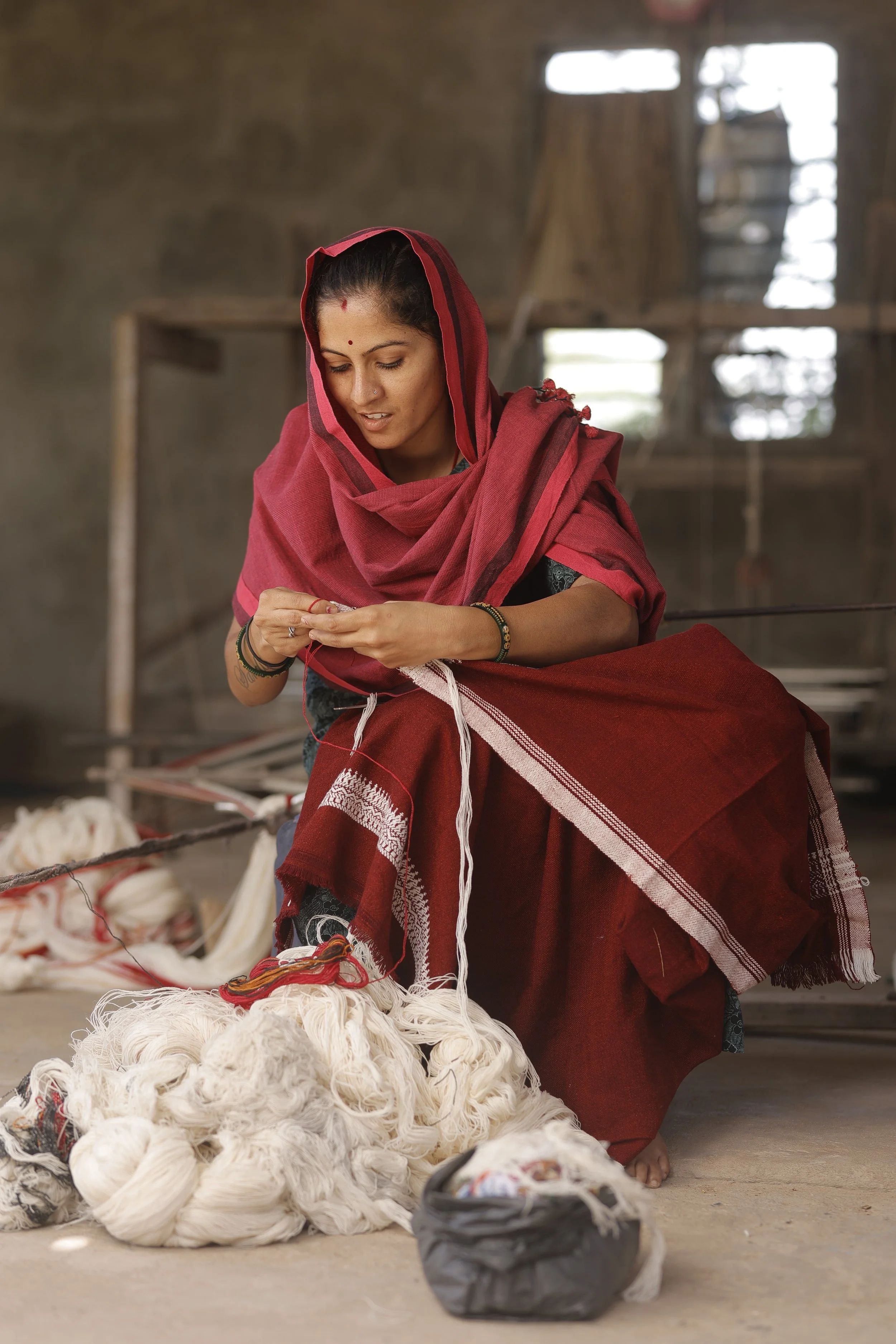
Finishing and salvage are the same skill: tassels being knotted onto a wool stole in the winter sun.
Women, in other words, hold the two ends of the process: everything before weaving and everything after it. It is at these two ends that failure is identified, managed, and transformed.
The waste that is never weighed
Here is the paradox at the center of this research: this cloth is deadstock in the ordinary commercial sense, that is, goods that have been produced but not sold. Yet handloom deadstock rarely enters a formal waste stream and therefore remains largely absent from waste statistics.
India’s textile-waste mapping largely follows the mill and garment economies, where tonnage is more readily measured through cutting-floor offcuts, sorted bales, aggregators, and the extensive textile trade in Panipat. Handloom waste rarely appears as a distinct category, partly because the volumes are modest but, more importantly, because such waste often does not reach a collection point where it can be weighed. Instead, it is absorbed at the site of production or enters the secondary market through traders, often with little or no financial recovery for the artisan who produced it.
For an accounting system, invisibility can look identical to zero. Consequently, circularity frameworks that measure only material flows through formal facilities may continue to report nothing where, in fact, materials are being reused, repaired, and transformed within households.
Circularity is not being invented; it is being overlooked
The mainstream conversation treats circularity as a downstream engineering problem: fibre-to-fibre recycling, take-back schemes, extended producer responsibility, and digital product passports. These approaches are necessary, but at present, many remain largely promissory. Meanwhile, a system that reabsorbs its losses at the point where they occur, without transport, sorting, chemical separation, or a dedicated campaign, has been operating in these villages for generations. It is small and local, and it will not scale in the way a closed-loop diagram implies. But it works, and it produces objects that people value.
There is a lazy version of this argument that ends in romance, and it should be resisted. The garland at the door is beautiful, but it is evidence of a loss assigned elsewhere in the production system. Both readings must be held at once.
This leaves the industry with two questions. The technical one is: what does a system look like when it returns or repairs material for use at the point of failure rather than at the end of a supply chain? The political one, and the harder of the two, is: who is absorbing your rejects for free?
What a study would have to do
For any cluster, a small set of answerable questions could provide a starting point. How much cloth is declared unfit in a year, and by whom: the master weaver, the cooperative, the trader, the buying office? On whose books does the loss sit? What proportion is reabsorbed within the household or the cluster, into what objects, and at what recovered value? What proportion simply remains unused?
Answer these questions across three or four clusters, and the result would provide a diagnostic of how much material a place can put back to work and where that capacity is being lost. Any brand claiming circular credentials could commission such a study, and it could reveal more about the practical functioning of circularity than another lifecycle assessment alone.
Such a study would require scales, household inventories, and extended conversations in the local language. It would require no new material technology.
An invitation
So, come. Not with a brief, not with a collection to launch, and not with a workshop to run. Organizations such as Khamir in Kutch have spent years making that kind of encounter possible. Sit in the room where the rejected stock is kept. Ask who decided it was rejected. Look up at the doorway on the way out.
The world does not need to invent circularity. It needs to become literate in the version that already exists, pay for the labor that sustains it, and carry the method outward. It is hanging above the threshold, in plain sight, waiting for someone to notice that it was never a decoration in the first place.
May 22 | 2026
Written by Hanisha Thirth
Photographed by Mohit Pawar